

Employers save $380 million when members use onsite occupational health
Employers face mounting pressure to reduce injury rates, control workers’ compensation costs, and maintain productivity amid labor shortages, aging workers, and rising workplace demands. Onsite access to prevention-focused occupational healthcare is uniquely positioned to mitigate cost and reduce harm to your most valuable commodity – your workforce.
The Findings
Our analysis supports that providing medically appropriate, evidence-based care helps organizations avoid substantial financial and operational disruption while getting members back to work and their lives safely.
A study of organizations across the occupational health book of business from 2022-2024 found cumulative savings of:
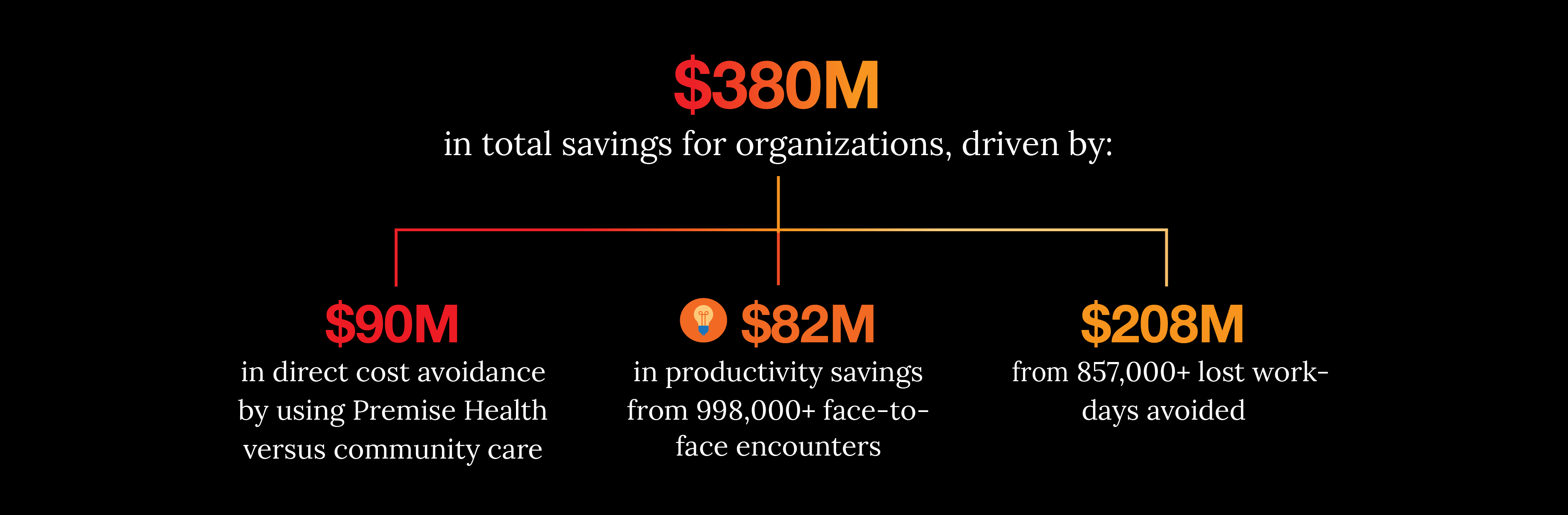

Why face-to-face encounters improve productivity: onsite care eliminates commute time and reduces time away from work for triage, evaluation, and follow-up. Members are often seen sooner or same day, care plans are coordinated in one setting, and managers get timely return-to-work guidance.
Lost Workday Reduction
Premise Health’s approach dramatically outperformed
industry norms:
90% of cases resulted in zero lost workdays
These outcomes show that targeted case management strategies that incorporate early intervention, medically appropriate treatment, and frequent injury follow-up, reduce lost workdays and speed up recovery.
Over 80% of all Premise Health injury cases resolved and closed in 90 days or less. While some cases take longer to close, this is intentional. Following a case until full recovery, rather than pressuring closure of the case, empowers the team to address the root causes of injury, ensure proper healing, and helps prevent the likelihood of re-injury.
Reducing Injuries,
Decreasing Downtime
63% of injuries treated were musculoskeletal-related, including sprains, strains, muscle weakness, low back pain, joint pain, and inflammation. As some of the most prevalent and costly injuries with the longest recovery times, even modest lost workday improvements in this category can have major impacts.
Premise saved 63.6 days on average per musculoskeletal injury case, totaling 465,500+ lost workdays saved between 2022-24. Emphasizing early intervention, addressing ergonomic risks, transitional duty, and the avoidance of unnecessary imaging and surgery plays a major role in our approach to reducing recovery time and days away from work.

Setting the Tone for Recovery
Through a new operational focus, adherence to following up with each injured worker within the first seven days post‑injury steadily increased from 62% in January 2023 to 82% by December 2025. The early post‑injury period is a critical determinant of recovery trajectory. Premise teams intentionally prioritize timely follow‑up to establish trust, confirm that recovery is progressing as expected, and support members during a clinically and emotionally sensitive phase.
These early touchpoints reinforce the care plan, surface potential barriers, align duty restrictions, and sustain engagement throughout recovery. The impact of this approach is measurable: Average lost workdays per case is staggeringly low at just 4.8 days compared to the national median of eight days.1 These results demonstrate how disciplined early intervention and consistent follow‑up translate directly into accelerated recovery and meaningful reductions in time away from work.
The Teams Behind Premise’s Injury Outcomes
Behind every successful recovery is an occupational health team that knows how to act early, manage effectively, and stay connected throughout the healing process. At Premise Health, our nurses and providers are specifically trained in occupational injury care and case management—equipping them to make informed, timely decisions that reduce risk, accelerate recovery, and support safe return to work.
Our approach goes beyond treating the injury. By applying a Total Worker Health® mindset, we consider the full picture—physical demands, psychosocial factors, and workplace conditions—ensuring care plans are both clinically sound and practically sustainable. Each case is benchmarked against evidence-based outcomes, allowing us to continuously improve performance and deliver measurable value to our employer partners.
Being onsite and easily accessible makes a meaningful difference. Employees receive care quickly, without unnecessary delays or barriers, which improves engagement and adherence to treatment plans. Just as important, our teams proactively follow up within the first seven days after an injury—a critical window that significantly influences recovery trajectory, prevents complications, and reduces the likelihood of prolonged disability.
This combination of specialized training, data-driven case management, early intervention, and convenient access creates a more responsive and effective injury care model—resulting in healthier employees, faster recoveries, and lower overall costs.

Beating Industry Benchmarks
As of December 2024, 96% of Premise Health’s case management cases closed with fewer lost workdays than the Official Disability Guidelines (ODG) best practice benchmark. Consistently high performance to this benchmark shows that our case outcomes are almost always outperforming evidence-based expectations for time away from work.
The Study
Premise Health conducted an analysis of work-related injury care and lost workday savings on 60 clients and 164 onsite health centers from 2022 to 2024. Clients were selected for this study based on use of OHM and Premise Health’s ability to benchmark lost workdays against ODG national benchmarks for work-related injury and illness care.
Industries represented:
> Manufacturing
> Public administration
> Utilities
> Retail trade
> Air transportation
The organizations in this analysis adopted a broad range of occupational health programs, with the majority leveraging core services such as injury and illness care, medical surveillance, workers’ compensation management, return-to-work services, and drug testing programs. Many also layered in complementary services such as ergonomics, onsite occupational therapy and physical therapy, virtual occupational health, and emergency response management. This demonstrates that results were achieved with a wide range of program models from high-touch integrated occupational health sites, to hybrid primary care, musculoskeletal, and virtual modalities.
Benchmarking Against Industry Standards
As part of our partnership with ODG, recognized for the industry’s most widely adopted evidence-based treatment and return-to-work guidelines, Premise routinely measures clinical performance against their nationally validated benchmarks.
ODG’s benchmarks are built on the largest lost time claims database and the ODG best practice guidelines have been shown to reduce medical costs, treatment delays, and disability duration across multiple states and organizations. By aligning our onsite model with these guidelines and comparing outcomes directly to ODG benchmarks, Premise demonstrates how its integrated approach consistently accelerates recovery and exceeds industry expectations for case duration, lost workdays, and return-to-work timelines.

- U.S. Bureau of Labor Statistics. (n.d.). IIF Latest Numbers. U.S. Department of Labor. https://www.bls.gov/iif/latest-numbers.htm.
Related success stories.

How one telecommunications company drove care access and improved employee engagement
Read the story
Biometric health screenings spark 81% of screened members to engage with primary care
Read the story