

A Tale of Two Patients: The Advanced Primary Care Difference
They say comparison is the thief of joy. But what if you have a healthcare experience worth bragging about? When you put advanced primary care at the center of healthcare, the difference is striking. Preventive, relationship-driven, and data-informed care helps providers catch health conditions early, manage them more effectively, and avoid the cycle of delayed treatment and costly interventions – saving employees time and organizations money. The difference in cost aside, this kind of healthcare experience leaves members feeling more like a priority and less like a patient.
To see how this plays out, let’s look at two very different healthcare journeys: Susan’s and Gary’s. Both are living with undiagnosed diabetes, but their experiences differ because of where they receive care.

Meet Susan, who has regular access to her primary care team through onsite healthcare provided by her employer. Susan gets a call from a care manager at her wellness center, who informs her she is overdue for her annual physical. They find a convenient time for her appointment, and she doesn’t have to miss any work to go to the doctor because her center is steps away from her desk.
When Susan arrives, her wait time is less than five minutes. Her doctor asks her about her health history, lifestyle, and access to things like transportation and healthy foods. Her provider also recommends a colonoscopy.
After completing bloodwork as part of her physical, Susan’s doctor calls to say she had a slightly elevated A1C level, indicating diabetes. They discuss her options, and because Susan is committed to making lifestyle changes, her care plan focuses on those changes instead of relying on medication.
Susan’s doctor prescribes a glucometer to measure her blood sugar, so she picks it up from the onsite pharmacy, where the pharmacist shows her how to use it. Susan checks in regularly with her care manager to discuss her lifestyle changes and make adjustments to her care plan. These touchpoints ensure Susan gets the whole-person, comprehensive support she needs.
Later, Susan’s electronic health record indicates that she went to the emergency room. Her care team sees this and calls to check in, learning Susan had chest pain from a panic attack, brought on by the toll of managing her diabetes. Her care team immediately connects her with the wellness center’s therapist. Now, she has support both for her physical and mental health. With her diabetes under control, it’s time for a colonoscopy. The care navigator helps Susan schedule it at a high-quality, affordable surgery center near her home.
Susan has managed her A1C levels and lost weight, and her colonoscopy also removed several polyps. Now she can play with her grandkids, with symptoms managed and worries addressed! Not only that, but both Susan and her employer saved money on Susan’s total cost of care because her diabetes was caught early and addressed quickly.
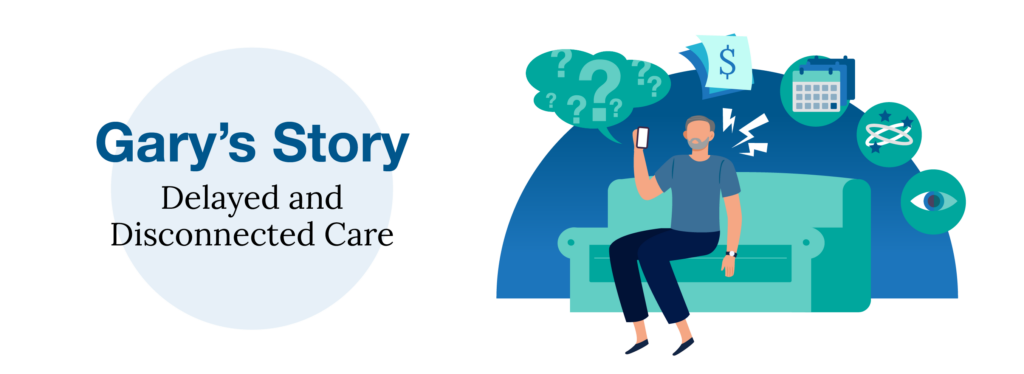
Meanwhile, Gary relies on the community healthcare system. He doesn’t have a care team that prompts him when it’s time for an annual check-up. He decides not to get a physical for another year, because he doesn’t have the time off work to sit for an hour in a waiting room.
Gary soon notices he’s experiencing extreme thirst, fatigue, and blurry vision. After calling his doctor, he learns it will take weeks to get an appointment. He goes to urgent care instead, where he is diagnosed with diabetes, prescribed a medication, and told to call his doctor. He waits at the pharmacy for a long time to get his prescription, and no one is available to answer his questions about the medication. It’s only after he returns home that he learns he could have been prescribed a free glucometer. Frustrated, he calls his doctor to ask for one. When he goes back to pick it up at the pharmacy, no one explains how to use it.
Now Gary is left navigating a fragmented system on his own. His doctor wants him to attend a diabetes education program at the local hospital, but it’s during work hours, and Gary cannot go. Without coordinated care, managing his diabetes feels overwhelming and lonely. He’s stressed, depressed, and has stopped taking his medication. He ends up passing out at work and goes to the emergency room in an ambulance.
After several days in the hospital, Gary is discharged with two new prescriptions: another diabetes medication and an antidepressant. He’s advised to see a therapist, but there aren’t openings for months, so he never goes.
Gary’s physical and mental health continue to deteriorate. Whenever he doesn’t feel well, he takes trips to the most expensive hospital in town since it’s the most convenient. He feels like no provider he sees truly cares about his health outcomes. His co-workers are worried, as is his manager, who recommends that Gary take short-term disability leave to get his health under control.
With time off work to manage his condition, Gary slowly starts to lose weight. But he’s still on his own, and he takes several medications a day. Gary’s manager is pleased that Gary is feeling better, but he knows this lengthy care journey has been costly for everyone. Between missed workdays and the expensive facilities where Gary received care, his employer is wondering if there’s a better way.
Why the Difference Matters
Susan and Gary share the same diagnosis, but their outcomes couldn’t be more different. Their stories highlight a fundamental truth: how care is delivered matters just as much as the care itself.
In Gary’s case, delayed access, disjointed providers, and transactional interactions left him feeling unsupported and overwhelmed. His health spiraled into emergency situations, costly interventions, and extended time away from work. What started as a manageable condition became a crisis, one that took a toll on both his wellbeing and his work.
Susan’s experience was the opposite. With advanced primary care, her condition was identified early and addressed in a proactive, coordinated way. Her providers had the time and resources to connect the dots between physical and mental health, ensuring nothing slipped through the cracks. The result? A healthier, happier employee who avoided unnecessary hospital visits and costly complications.
When advanced primary care is at the center:
- Prevention is central. Conditions are caught early before they escalate into emergencies. Proactive screenings and whole-person wellness visits uncover risks before symptoms appear.
- Care is coordinated. Services are integrated and seamless, eliminating confusion.
- Relationships are prioritized. Providers spend meaningful time with patients, building trust and fostering open communication that drives engagement.
- Costs are lower. By avoiding downstream care like ER visits, employers save significantly while employees live healthier lives.
- Employers benefit. Healthy employees are more present, productive, and engaged, while organizations avoid the ripple effects of absenteeism and high claims costs.
For employers, unions, and other organizations, prioritizing advanced primary care means healthier people, lower costs, and a more sustainable approach to healthcare. It’s time to reimagine what advanced primary care can do — for your people and your bottom line.
Want to learn how advanced primary care can benefit organizations like yours? Contact Premise today.
Next on industry insights.

What Really Happens During Your Annual Physical?
Read the Blog
Driving Business Success by Investing in Employee Physical and Mental Health
Read the Blog